2013-10-22

new release: The Sanity Paradox

I hope J. William Latimer will forgive tardiness of this announcement.

His debut novel, an international conspiracy thriller, The Sanity Paradox, was released on October 15.

Here's an extract from the blurb:

When famed author Samuel Grayson finally sobered up, he gave up more than blackouts and bouts of
depression—he lost the voice of the fictional undercover cop that made him a household name. In a desperate bid to save his career, Grayson agrees to meet with a secretive publishing firm aboard a popular Niagara Falls tourist boat. But restoring his prominence in the crime fiction business isn't his only motive. The potential publisher had repeated three simple words that have haunted Grayson for decades—three words no one should have ever known.

I really enjoyed working on this book; it has all the usual elements of the conspiracy thriller: charismatic gurus, secret cyphers, Ivy League intellectuals, bewildered blue-collar law enforcement professionals, international travel and twists galore.

What I think sets it apart is that Latimer has a really strong underlying professional knowledge of his subject matter, which enables him to use it with the very structure of the narrative, and provides, by the end, an original twist on the meaning and purpose of a literary protagonist.

2013-10-10

It's not about the breasts.

So, yesterday's post got a ludicrous number of hits, and a small minority of the visitors stayed to actually read what I said.

Which was nice.

But looking at the two comments I got (and some "behind the scenes" feedback) I think I may have shot myself in the foot with that title. The first commenter thought that I was offended by the size of Monica's breasts and the second thought I was objecting to it or complaining about it.

Paul Taylor sent me a brief and polite email where he seemed a lot more interested in my criticism of his slightly disjointed storytelling than of his use of visual cues. Which is fair enough.


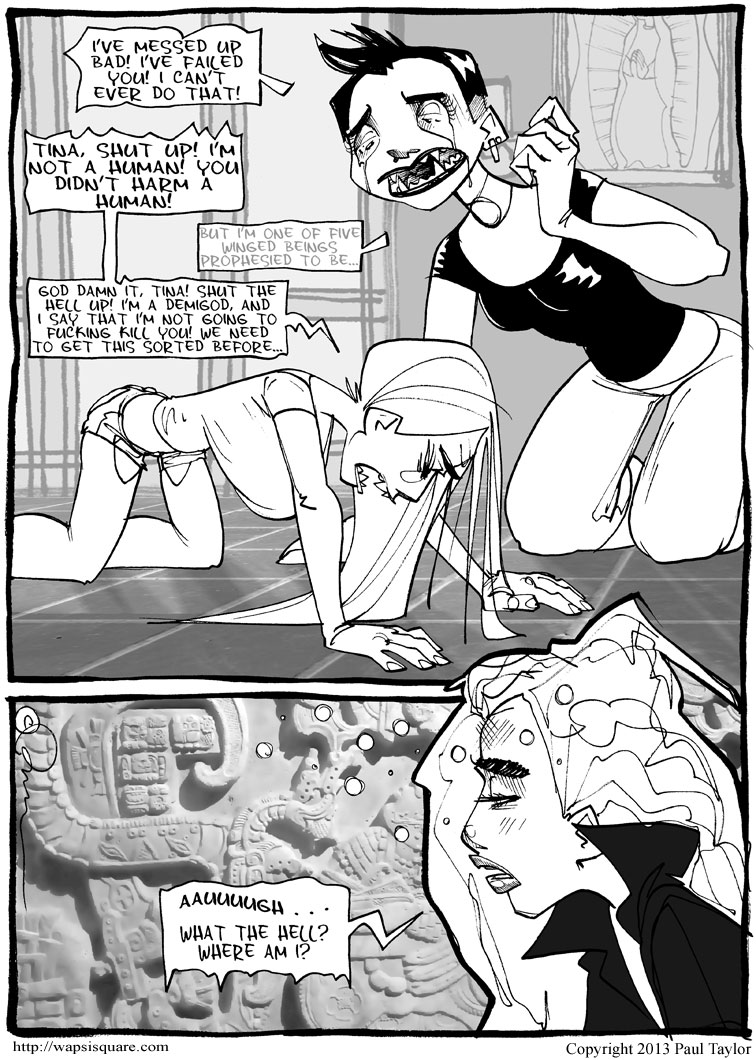
I happen to be a fan of Taylor's work. My daughter has a poster of this image on her wall. I wanted her to have it because I think it both showcases Taylor's talent for composition and colour and for the distinctiveness of his style, and is a terrific representation of female body confidence. Somehow he has painted two young women who are sexy, not because they are suggesting that they are available, but because the make me want to get to know them.

If it's not about the breasts, what is it about? It's about symbolism. As usual, I'm going to try and fail to avoid being pompous and intellectual.

In 1957 the French critic and literary theorist Roland Barthes published an influential and important book, Mythologies. The central thesis of Mythologies is that in visual media (he concentrates in particular on cinema) there is an established language of visual cues that he calls "signs". I have already mentioned this in another post. Russian theatrical experimenter Vsevolod Meyerhold developed a system for actors intented to make them hyper aware of their every movement and gesture, because, he maintained, everything the audience can see has meaning for them. Therefore, actors should not even move unintentionally, knowing that every movement will mean something to someone watching. By extension, movement and gesture can then become a means of active and deliberate communication.

These are two examples of visual language.

In textual fiction (novels, novellas, short stories, epic poetry, etc), visual language also exists. It is present in obvious forms such as simile, metaphor and emblem. But it is also present in a more pervasive and less obvious form: symbolism. Imagine a Regency novel about the rise and subsequent fall of a country gentleman. All the major events in the story take place in and around a water mill. The reader gradually builds up a mental picture of the mill, and through careful writing, the author ensures that the wheel becomes more and more dominant in that mental picture. The wheel is of course a symbolic representation of the medieval idea of the "Wheel of Fortune" - an idea that is still a resilient element of our culture.

Comics and graphic novels are a mixed medium. The use both text and pictures - and many of them use both textual and visual examples of visual language.

So getting back to Wapsi Square. In my opinion, and he can object if he wants to, Paul Taylor is creating art. If I feel that at the moment his visual talent is more developed than his storytelling talent, it isn't to say that there isn't clear evidence that both are improving and developing. And I feel that his style is now doing a disservice to his message in some cases.

Let me contrast this with another webcomic, where the creator keeps his symbolism simpler, but is, in a way, delivering the same general message.

Consider J.E. Draft's Zona. Draft is properly unashamed about his adulation for the female body, but his artistic style is derived from his medium. In my opinion he has made his own life very difficult by chusing to use Poser to create scenes and then adding detail, effects and subtlety to them in a (sometimes complex and time-consuming) post production phase. However, using Poser gives an impression of realism.

Draft is also a good story teller. Zona moves forward at a generally even pace, it has solid plot construction and steady internal coherence. One thing that comes across very strongly is that the worlds (there are two) in which it is set are well thought out, and highly detailed. It has it's weaknesses, but they aren't germane.

Probably the first thing you will notice, however, is that the central characters undermine the standard male
 fantasy archetypes - while still playing along. It's a clever piece of tightrope walking that I suspect comes naturally to Draft. The two main characters are the titular Zona and Mentl.

They are a loving and affectionate couple, and Draft is not afraid of showing it. Zona is extremely buxom, but it is she who is tall, muscular and powerful - she even has a big, masculine jaw. Mentl is short, a little on the skinny side, and has a face that is very far from being "conventionally handsome". Indeed, all of Mentl's attractiveness is in his personality. He is non-confrontational, sensitive, honest, kind, loyal. The third regular character is Zona's sister, Tula. Also drawn as an "Amazon", she isn't nearly as tall and muscular as Zona. But Tula is the smart one. Indeed, Tula is a genius.

In other words, the major characteristics of the male power fantasy archetype, physical and mental prowess, have been given to the main female protagonists. One might argue that characteristics that are stereotypically (for which read, "not always true") female have been assigned to the male protagonist.

Are the women sexualized? Yes, but. And it is a big but and you have to read the whole comic to realize why. The culture that Zona and Tula come from is one where many human interactions are sexualized. It is a culture that is completely without sexual reserve of any kind, which occasionally makes Mentl uncomfortable.

So, does Draft take that to its logical conclusion?


Draft's message is simple and plain: people's good qualities are complementary. Match the right people with the right variety of qualities and they can achieve great things. And most of all: you can't tell because of someone's gender what qualities they will possess.

In exactly the same way as Taylor, Draft is telling his reader that prejudice is of very little practical use.

Draft and Taylor take different approaches in artistic technique, and in their use of visual language.

Draft's apparent realism means that there is little risk that his visual language will be misconstrued. However his celebration of sexuality may offend some people, and the pleasure he takes in representing semi-naked women may lead those who don't read his comic to believe that he is just another Neanderthal.

Taylor's stylization leads him to a completely different risk. That his visual cues may be dissonant with his message. It's a difficult target to hit, especially when he is sometimes aiming to be dissonant.

***

I'm still not completely confident that I will have managed to make myself understood. But remember, this blog is supposed to be for writers, to make them more sensitive to technique, so that they can better understand and improve their craft.

And finally, thank you to both commenters. Noone should ever feel that they daren't voice their honest reaction.
2013-10-09

"Monica's boobs are getting on my tits."


First, I apologize for the title of this post; I was careful to put it in scare quotes, but understand that in spite of the impression you might have got of me from my recent interview on Rocking Self-Publishing, the title of this post is an accurate representation of how I really talk.

I know I have already intimated that I am a regular reader of webcomics, and I may even have listed my regulars somewhere.

Among those is the generally excellent Wapsi Square. Wapsi went from being a carefully* drawn casual webcomic about a "small group of twenty-somethings getting up to hijinx with obligatory supernatural mascot" to a beautifully and distinctively drawn comic with a sense of humour that regularly deals with serious subject matter through supernatural (and increasingly allegorical) storylines that occasionally seem to retcon the only medium that can't be convincingly retconned. As such, you have to keep up to date or you can find yourself in big trouble.

If you don't keep up to date, and decide to go on an archive binge, you have to be prepared for the following repeated WTF moments:

  • I remember him/her/it/that... whatever became of him/her/it/that?
  • wait, she has super powers now?
  • wait, she has super powers too?
  • How old did you say you were?
  • Oh, now she's indestructible.
  • No, wait, just immune to bullets.
  • No, really indestructible... 
  • and so on
In a way, all this is par for the course. Certain long running webcomics, of which I guess one of the major grand daddies is Sluggy Freelance, shows that you can not only continually reinvent certain characters (provided other characters develop in a more conventional way), but you can (and probably should) lampshade the fact (warning: that last link was to TV Tropes. Only follow it if you have time to kill. ). Aylee the alien regularly changes appearance and personality throughout the first few years of the comic.

Somehow, we accept plotting oddities, incursions from other fictional worlds and total overhauls in webcomics that would be utterly unacceptable in other media.

Wapsi Square makes up for its oddities with some strong and compelling central characters (Monica, Shelley, Tina, Katherine, Phix), and Wapsi's creator Paul Taylor even pulls off the improbably coup of giving the impression that we the readers are still just beginning to get to know those characters, familiar though they have become.

As with all long running webcomics, Wapsi has also seen a significant transformation in the artistic style, as Paul Taylor has developed from a newb comic scribbler into, let's face it, an artist.

His style looks slapdash... a lot less careful than those early strips. But he seems to have discovered how to cram all the necessary emotion onto the faces of his characters exaggerated eyes and teeth notwithstanding.

So... to the boobs.

Dig a little in the archive and the forums, and you will discover that there is a sensible-ish reason why Monica's boobs are so disproportionately huge. And indeed, the disadvantages to her distinctive distinguishing anatomical feature are explored honestly (though not without a little humour). Having said this, as Taylor's style has become more and more individual and differentiating, it has developed into a style that emphasizes details of characters' appearance. As a result, Monica's boobs have got bigger and bigger.

Now, there are times where a little exaggeration goes a long way, and not just for comic effect. And Taylor also draws what I think are joyous and liberated old school pin-ups of his main character where the exaggeration is also ... forgivable.

And those boobs can also be useful for leaving us in no doubt that even transformed into an embodiment of righteous rage, this is still Monica.

However...

Increasingly often, Monica's physique is distracting to the point of undermining an otherwise liberal, equal, empowered treatment of women**, both in terms of character portrayal and in the underlying symbolism of the stories.

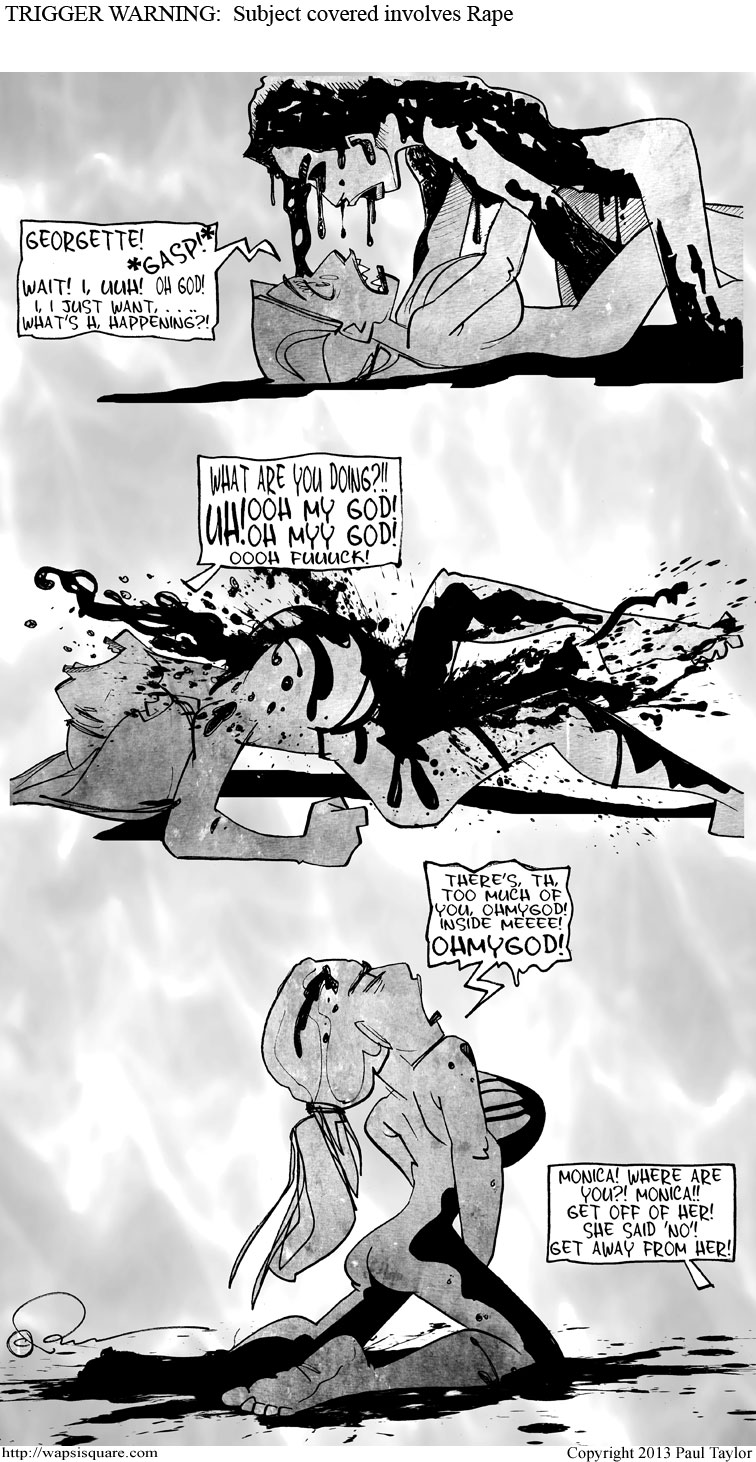
In today's comic (pictured above), the distraction is underlined because Tina's torso is much more natural than Monica's. This is true of pretty much all the other characters. They look like cartoony exaggerations of realistic physiques - even the supernatural ones. Whereas Monica has become increasingly "impossible".

The scare quotes around "impossible" are there because there absolutely are real women who have a petite figure and impractically large breasts, and all the risks, problems, prejudice and stigma that go along with that. So if there are people in real life who have that physique, surely it's fine?

It isn't fine, though, because a webcomic is a story, and stories are about what it means to be human, and visual media in particular, communicate their cultural message visually as well as through words and stories.

Cephalopod Monica (see footnotes) does not create a problem. Whereas sharp-toothed Monica (in Taylor's style of today) creates a visual dissonance with the emotional subject manner that is undermining rather than unsettling.

In my opinion, Taylor could dial back Monica's boobage just a little, and the original sense of a character whose personality, intelligence and personal empowerment is entirely contrary to the expectations imposed by an excessively sexualizing culture will be recovered.

Ahem. That's one of those sentences again. Let me try again.


Monica is drawn and written as a contradiction. This is good. She is drawn in way that makes her look as if sexuality is her primary characteristic. She is written in a way that shows that it is not. This exposes our culture's visual prejudice towards women. This is an important message but it can't be the ONLY ONE. The current mini arc (obscure though it may be) is not about this. It's about rape. And the boobage is undermining the message (that treating a woman only as a means of sexual gratification is not acceptable).

Mini disclaimer:

Most women, I hope, don't need to be told about this particular message, and I'm sure the many women who read and enjoy this webcomic are much less distracted from the message by the boobs. What I'm saying here is that I am. And I suspect I'm not the only male who is.

____
* I had a hard time coming up with the right word here. Sometimes those early strips seem to be populated with jello-people. "Sally's Bar" is really the first place where you discover that Taylor can draw people rather than cephalopods.
**I'm trying to avoid a particular word. Can you guess what it is?