First an apology. I've been nagging Dawn McCullough-White to write a sequel to The Emblazoned Red. This is partly because I really like this book and partly because I really like Dawn's work in general. There's something very particular about the experience of reading it; an atmosphere, a sense of presence, that seems to be unique to her style and presentation, and imagination.
My apology is that while I have already mentioned the book on my blog, until today, the cover was not on the right hand column of this page. I don't know what difference, if any, that would make to readers discovering this book that certainly deserves to be discovered, but it's something I ought to have done, and have not.
I'm also apologizing to Ray Kingfisher, whose excellent, slick, funny Easy Money has also not shown on this page. Easy Money is dedicated to the late Tom Sharpe who died in June of this year. If you read it, you will see why.
The Emblazoned Red is a book that manages to combined the defining characteristics of several genres into a coherent, convincing, artfully imagined world. But it really doesn't conform to any of those genres. It reads like a regency romance, but the main character is an armoured knight who fights the undead and falls in love with a pirate.
If you sat down and said: "I'm going to combine vampires, zombies, pirates, paladins and highwaymen into a bodice ripper" you'd surely have a recipe for disaster, but a good book doesn't come from a recipe.
It comes from a strong story idea, that is worked into a strong story; that has characters that you care about, that compel your interest and attention. That is what Dawn delivers. That it takes place in an imaginary world where the difference between living and dead is ... less clearly defined than in our own ... is just part of her creative vision. I find her world-building almost effortlessly transporting even when it is a little sparse. So the lack of a true, defining genre shouldn't represent a problem.
But the organ by which we distribute our works depends on classification. How else can one writer claim he is #1 in Books > Science Fiction & Fantasy > Science Fiction > Post-Apocalyptic and another be #1 in Books > Science Fiction & Fantasy > Science Fiction > Steampunk and so on. All this enables readers to find what they want and the maximum number of writers get the maximum of exposure.
Provided they are writing genre fiction. Amazon has a category Books > Literature & Fiction > Literary. Honestly it's a bucket. The last place you want to be if you want to get noticed, and look at any book in the top ten in that category and you'll see that it has a high ranking in two or three other categories.
It's all about the categories.
Which is a pity, I think. I wonder how many readers do not actively seek the next Kindle Store > Kindle eBooks > Literature & Fiction > Women's Fiction > Sagas or Kindle Store > Kindle eBooks > Literature & Fiction > Contemporary Fiction > American... and just want to read a good book, regardless of how it is categorized.
If I searched by category for the the type of book I thought I might like, I'm pretty sure I'd never have encountered any of
Dawn McCullough-White's work.

2013-10-31
Editing Update: Originality in heroic fantasy? ...
... and a second draft I've been looking forward to for a while.
I'm about to start working on the first book of C Ryan Bymaster's Echoes of Power series. Bymaster's English flows very readily, and is a pleasure to read, although his diction gets a little experimental in places and his grasp of paragraph breaks, especially in direct speech is, like the rest of you, nonexistent.
What I like about what I've read so far is that he has hit upon an original* magic system that is also pleasingly intuitive, and therefore probably requires even less explanation than he has actually given.
In addition, Jarmila Zaricka sent me the second draft of her unusual, philosophical, novel of self-realization. I haven't so much as glanced at it yet as I want to save the treat for when I can sit in my cozy armchair and really savor it.
_____
* for a given value of Frank Herbert. Nothing is ever original, and the magic system owes various debts in various places, but in the setting, it's pretty innovative.
2013-10-28
In which I try and fail to review a book ...
... and end up generally rambling on, as usual.
A few weeks a go, I worked for the first time with (yet another) Florida Keys Noir Crime writer Jessica Argyle. It's okay. I love that stuff. And Jessica's book is as close to proper literary fiction as self-conscious modern genre fiction gets. No Name Key is part history, part crime, part sweaty-insect-bitten-marooned-in-the-everglades drama. It may be a little retro, but it is also shouting for the core of the women's movement.
Not really shouting, actually. It's more that kind of throaty growl of a she-wolf hidden in a thicket that means "we both know you know I'm here; don't make me come out there."
No Name Key is a damn fine book and I'm impatient for its publication.
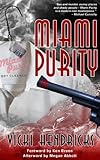
Anyway, when my authors go to the trouble of recommending a book to me, I generally have a damn good go at actually reading it, and Jessica suggested I read Miami Purity by Vicki Hendricks.
This is where I try to review it.
I'm going to start with the cover. I don't usually bother talking about covers of published books, but I really hate this cover, so I'm going to talk about it. The type face (font) is a disaster. It makes it look like this is classic noir, and it just isn't. I'm expecting all women in long dresses and guys stuffed into dinner suits and some plot that turns around a laundry ticket for a coat that has some incriminating evidence in the pocket. Some run of the mill retro rich white folks and private dicks.
That ain't it. The cover needs to scream, sex, betrayal, and weird, skewed, awkwardness. It shouldn't be slick.
See here, Miami Purity, about which I'm going to say something like "I really wanted to like it, and in the end I kind of did", is a book about the way that just being at the extreme end of one of the various scales of being human can make your life a weird-arse awful mess.
I had to really fight with this book to get to the end though, because the story, such as it is, doesn't keep pace with the characters. It doesn't know where to go. Partly this is because there are three clearly identifiable places where the author has said to herself: "that's a big damn crime fiction cliché right there. I'm not going there" and by not going there has kind of gone nowhere, and then on one of them, played a cliché right back by retconning a hidden twist. (All right, it might not have been a retcon, but it was painfully opportunistic and obvious. (I'm talking about the way in which Payne deals with his "rival for Sherri's affections".))
What I think goes wrong with the story is that the author loses confidence in the characters, starts to worry that they can't manage on their own, and eventually lampshades the fact that it's the characters who are driving the story, but not through what they have done so far, just through their personal character flaws. ("I told you, she'll fuck up and leave. She'll fuck herself with her drinking.")
In the end, I think that the author should have taken the risk, done the clichés and watch the fun as unexpectedly convincing nymphomaniac, exhibitionist alcoholic Sherri stumbles from one screw up to another.
Some reviewers will, I'm sure, have complained that there was too much sex. Well there was, for the story, but not for the character of Sherri. The saturation level shagging is essential. It's the only way to get across to the reader just what it is like to be like that. It isn't erotic. It isn't even funny. Sometimes Sherri gets what she's desperate for, and it's a very brief relief. That is good, daring, successful writing.
What I'd like to see from this author is a simpler, less original story, a lot more awareness of her own themes so that she can explore, inform and entertain, and push the originality and believability of the characters towards and beyond the limits of what readers will readily accept.
A few weeks a go, I worked for the first time with (yet another) Florida Keys Noir Crime writer Jessica Argyle. It's okay. I love that stuff. And Jessica's book is as close to proper literary fiction as self-conscious modern genre fiction gets. No Name Key is part history, part crime, part sweaty-insect-bitten-marooned-in-the-everglades drama. It may be a little retro, but it is also shouting for the core of the women's movement.
Not really shouting, actually. It's more that kind of throaty growl of a she-wolf hidden in a thicket that means "we both know you know I'm here; don't make me come out there."
No Name Key is a damn fine book and I'm impatient for its publication.
Anyway, when my authors go to the trouble of recommending a book to me, I generally have a damn good go at actually reading it, and Jessica suggested I read Miami Purity by Vicki Hendricks.
This is where I try to review it.
I'm going to start with the cover. I don't usually bother talking about covers of published books, but I really hate this cover, so I'm going to talk about it. The type face (font) is a disaster. It makes it look like this is classic noir, and it just isn't. I'm expecting all women in long dresses and guys stuffed into dinner suits and some plot that turns around a laundry ticket for a coat that has some incriminating evidence in the pocket. Some run of the mill retro rich white folks and private dicks.
That ain't it. The cover needs to scream, sex, betrayal, and weird, skewed, awkwardness. It shouldn't be slick.
See here, Miami Purity, about which I'm going to say something like "I really wanted to like it, and in the end I kind of did", is a book about the way that just being at the extreme end of one of the various scales of being human can make your life a weird-arse awful mess.
I had to really fight with this book to get to the end though, because the story, such as it is, doesn't keep pace with the characters. It doesn't know where to go. Partly this is because there are three clearly identifiable places where the author has said to herself: "that's a big damn crime fiction cliché right there. I'm not going there" and by not going there has kind of gone nowhere, and then on one of them, played a cliché right back by retconning a hidden twist. (All right, it might not have been a retcon, but it was painfully opportunistic and obvious. (I'm talking about the way in which Payne deals with his "rival for Sherri's affections".))
What I think goes wrong with the story is that the author loses confidence in the characters, starts to worry that they can't manage on their own, and eventually lampshades the fact that it's the characters who are driving the story, but not through what they have done so far, just through their personal character flaws. ("I told you, she'll fuck up and leave. She'll fuck herself with her drinking.")
In the end, I think that the author should have taken the risk, done the clichés and watch the fun as unexpectedly convincing nymphomaniac, exhibitionist alcoholic Sherri stumbles from one screw up to another.
Some reviewers will, I'm sure, have complained that there was too much sex. Well there was, for the story, but not for the character of Sherri. The saturation level shagging is essential. It's the only way to get across to the reader just what it is like to be like that. It isn't erotic. It isn't even funny. Sometimes Sherri gets what she's desperate for, and it's a very brief relief. That is good, daring, successful writing.
What I'd like to see from this author is a simpler, less original story, a lot more awareness of her own themes so that she can explore, inform and entertain, and push the originality and believability of the characters towards and beyond the limits of what readers will readily accept.
Subscribe to:
Posts (Atom)