2012-01-24

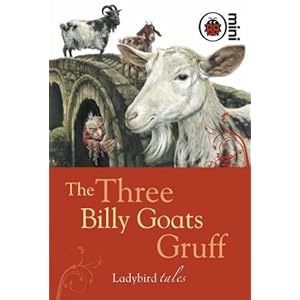
Three Billy Goats Gruff


Like many short fairy tales for younger children, this story has resisted attempts to pin an obvious moral on it. It is based on the archetypes:

protagonist achieves heart's desire through guile
protagonist overcomes antagonist through guile and main strength
three brother tale
the monstrous gatekeeper

The heart's desire is the green grass on the other side, but don't be fooled. There isn't a "grass is always greener" Aesop afoot here. On the other side of the river the grass really is better, and this is confirmed once it is tasted. You can argue until you're blue in the face about the lesson here, there isn't one. In many traditional tales, a wish to be fed is fullfilled, and lends weight to the idea that reading about a feast helps to alleviate hunger (as well as making it worse for some people).

The tale makes very strong use of rhythm - as announced by the title. It is possible that "billy goats" were selected as heroes for the rhythmic quality of the phrase "three billy goats gruff". Peasants will remember that male goats, even brothers, will rarely tolerate one another. So we can assume that they "aren't really goats". This is where it becomes a classic "three brother tale" — any hero who sets out on a quest that has already claimed the lives of his two older brothers is absolutely guaranteed to succeed. Where TTBGG makes this more interesting is that the first two brothers both meet the danger with guile, passing it on in turn to a stronger older brother. In the classic three brother scenario, it is the youngest who succeeds, usually through guile or with the aid of magical helpers or talking cats.

In this case, the eldest brother doesn't even take the time to complete the repeated rhythmic mantra, but directly, and with no fuss, overcomes the troll by the most direct means available: butting him into the river.

There are lessons for writers and storytellers in this story, not just lessons for children. I have often wondered what Aesop would have made of it. He was a smart man, so he would probably have thrown in the towel.

The monstrous gatekeeper addresses the injustice of feudal europe that is, sadly, hardly less present today: that a few individuals have power over critical structures or resources. This is a story that teaches that those who haven't the strength to rebel should use subterfuge to escape control, while those who do have the strength should rise up in bloody insurrection. Okay, maybe that's a bit strong, but the trope is there.

Finally, this story contains an essential staple of the fairytale, that of structural and verbal repetition. Indeed it takes the verbal repetition to a point where the children not only feel it is acceptable, but necessary, to join in. Each goat is bigger, so his feet make a louder sound, so each time the (poor) troll has to shout his challenge louder, and the balance of the defiant sound (trip-trap, trip-trap of the goat's hooves) with the troll's challenge (who's that trip-trapping over my bridge) provides the children with an advance warning of what will happen in the end.

In terms of its influence, the most obvious place is Roger Hargreaves, who frequently uses the same devices in his stories, and frequently subverts narrative convention in the same way that this story does. In Mr Tickle, the eponymous character has arms so long he can reach across more than one page. Terry Pratchett is both consciously and unconsciously influenced by this story. I suspect its legacy is very great indeed, as it tells storytellers that you can make a good story by combining strong conventions with deliberately misused conventions. It also tells us that we can, and should, be subversive in what we teach even to the very young!

Probable, reasonable, realistic — stories

Supposing I set you a simple problem, that requires a little knowledge of the mathematics of probability:

A simple, discrete, independent and isolated test has two possible outcomes, A and B. The probability of each outcome when the test is run is 0.5 (one half). I run the test 10,000 times. Every time the result is A.

a) What is the probability of getting outcome A 10,000 times in a row?
b) If I run the test one more time, what is the probability of getting outcome A?

I remind you, the above is a math test question.

I think the answers are:

a) 1/(210,000) (one over (two to the power ten thousand))
b) 0.5 (one half)

Now, suppose I ask you a different question:

This morning, I spent my time rather frivolously tossing an English Fifty Pence Piece. This is a standard coin minted in the UK to acceptable quality levels. It has a clearly distinguishable head and tail, and because of its shape, rarely lands stably on its edge.

I tossed the coin ten thousand times, give or take. Every time it came down heads. I was careful to vary both throw and catch height. Sometimes I allowed it to land on the floor, sometimes I threw it over my shoulder and sometimes I kept my eyes shut (to avoid quantum).

My questions are:

a) what are the chances of that happening?
b) will you take a bet of one dollar if I say that I reckon the next toss will come down heads?

***

I contend that there is only one approach, and only one answer to the mathematically expressed, theoretical question about outcomes A and B.

However, the real world example may be answered in any of three ways. Two are mutually exclusive, the third might be seen as a modified combination of the other two.

The first approach is the purely mathematical. It gives the same precise answer to a) as I gave above, and the same precise answer to b) as I gave above. Mathematically, it is correct. But I have been telling you an anecdote about a real-world event that took place this morning. Theoretical mathematics assumes that the test is subject only to the stated constraints. (In Rumsfeldian Notation, there are zero known unknowns and zero unknown unknowns.) The result is that we cannot trust the mathematical answer in the real world. Will you take the bet just because the math says that heads and tails are equally likely?

The second approach is based on what is often called The Law of Averages. This law arises from an incomprehension of the math of probability - or an attempt to infer a real world rule from a mathematical statement of probability. The Law of Averages states that if two outcomes are equally likely, then the more times you test, the more the number of times each outcome occurs will tend to equalize. It supposes, therefore, that each time I get heads, tails becomes slightly more likely in the next toss, so after 10,000 heads, tails is extremely likely. If you think like this you'll have taken the bet without hesitation. You will be just as wrong as the mathematician.

The third approach is known as induction or inductive reasoning or proof by induction. It doesn't matter too much why it is called that. In matters of repeated events, induction assumes that whatever happens most often is most likely. In real world situations, this assumption is the only approach which enables you to allow for unknown factors without even trying to know them. If you are naturally suspicious, you will already have assumed that I haven't told you everything about this mornings events, or that I am lying to you (shame on you!). Consequently you will assume you will lose your money and you won't take the bet. This is wise, but the wrong reason to refuse the bet.

If you reason from the evidence available: 10,000 reported heads; you will conclude that there is some unknown factor that is making heads much more likely. This is inductive reasoning. You use this for a whole lot of other things. It frequently gets called common sense, or intuition. In the real world, induction – evidence – is much more reliable than mathematical theory, and both are more reliable than the Law of Averages.

The Law of Averages and induction both arise from our tendency to turn everything into stories. The Law of Averages is a sort of "Story of Probability", while induction is a "story of evidence". Our ability to turn things into stories is essential in real life, where there are always huge numbers of unstated constraints - unknown unknowns. Without stories, we can't predict the future, and we need to predict the future to survive. If you don't believe this, just answer me this: do you wait until you are hungry before you eat, or do you eat at set times to avoid hunger? The former is reacting to the present, the latter is predicting the future by telling yourself a story. Probably one about a little bear who didn't eat his dinner. Which since this is my story, was probably salmon, rather than porridge. Or do bears have that for breakfast? Or was that little girls? One thing is certain. Little girls rarely eat bears. There is probably a story that convinces them not to.

I blogged recently about the chimera of Planning. Planning is also storytelling — people will judge your plan a good one if it makes a convincing story.

Much of people's behaviour is determined by which stories about the future they believe, and which they don't. Soap Opera exploits this by creating characters who constantly believe the wrong stories. The tension between the story that the character believes, and the one the audience expects, is the origin of almost all drama.

Even those of you who won't take my bet because you are suspicious are succumbing to a belief in a story that conflicts with the story I told you. The story you believe is that the coin must sometimes come down tails if both are equally likely. The mathematician will tell you this is not so, and you are a fool to believe the story. He is wrong. Conflicting stories, both of the past (evidence) and the future (expectation), are our best and strongest indicators of error, accident and misdoing.

Indeed, I did not toss a fifty pence coin 10,000 times. I do not own a fifty pence coin, and I don't have time for that sort of thing. I was telling you a story. I'm sure that's obvious by now.

2012-01-23

What to expect from an editor #3: What to expect from me

As I am planning an update of my website, I've been thinking about how I set out my stall. To this end I have been re-reading past posts that deal with my literary ideology, as well as those that deal with what I think editing is all about. By the end of this post I hope to come up with additional expectations for editors and authors.

Here are some past posts about this sort of thing. There are more, but this post is already long enough.
I have also made use of the wonderful educational tool, InspireData to help me think about how I think about editing:

Each of these diagrams shows the same set of editing "interventions" (e.g. spelling, grammar, diction, punctuation) sorted via Venn diagramming three different ways, first by general editing domain, then by the type of checks (or controls) used, and then by the origin or source of those controls.

The broad outcome of this analysis is that in my thinking, editing can be divided into four general domains, as follows:

  1. PresentationPresentation includes all interventions whose primary purpose is to assure and maintain readability in print. Much of this work is done by electronic typesetters (formatters). This is the expert in page layout, font and onscreen presentation. If you intend your work to be read on more than one type of device or screen, you should go to a formatter. The main work of the literary editor in this area is in aiding the author in making his choices, such as localization of spelling and punctuation, and selection and application of a consistent style and format.

  2. Linguistic. Initially this was the domain that was hardest to define in such a way as to separate it from the others. You can see from the first diagram that nothing is solely in this category. (I could create an arbitrary intervention called "grammar" and put it there.) Linguistic interventions are all those that deal with word selection and word use, however there is significant overlap with the third domain, narrative, in features such as POV, person, tense - linguistic intervention in such cases concerns the consistent execution of these choices.
  3. Narrative. Narrative elements of your book are based on your choices, conscious or unconscious. There are many features that appear only in this section, and those which overlap overlap with linguistic inasmuch as linguistic concerns will determine the effectiveness of your narrative techniques.
  4. Oversight. Has no sector (since InspireData doesn't do four sector Venn diagrams). Those outside the other sectors are all ones which can be an embarrassment if they are not controlled. Practical concerns are those outside of the book itself, such as marketing and distribution. Factual is what it sounds like; authors and editors must verify information presented as fact, even in a fantasy novel. Originality deals with copyright, disclaimers and plagia (unconscious or otherwise). Inside the Narrative domain are three others subject to oversightfeasible, naturalistic, realistic. There is a close overlap between these three, but in short, feasible is concerned with whether an imagined thing is really possibly; naturalistic is concerned with trying to write events and people that occur and behave like in real life as contrasted with stories; realistic is concerned with whether the reader will be able to believe the story or indeed, suspend his disbelief.


The purpose of this analysis is not to create something new; it is to describe what I am already doing, what I have always done, and how it has evolved in the light of the indie publishing phenom.

Two major points arise from the co-evolution of indie-publishing and literary-editing-for-indie-publishing:

1. Formatters can do all the layout work. The opinion and advice of the formatter is valuable when making stylistic choices within the domain of Presentation. Editors and writers should both be aware of this.

2. While many editors will, for their own comfort or ease, or the comfort or ease of their writers, continue to apply style and format using the Chicago Manual or the Economist Guide; will continue to refer to dominant arbiters over word use and meaning, and over grammar and (especially) syntax, the author who is confident of the value and clarity of his personal preferences can ignore all authority if he wants to.

In the case of 2 above, I think that the author has a duty, and the editor a responsibility, to ensure that the author's eccentric, esoteric or merely mildly divergent choices remain consistent within a given book (so they do not confuse or alienate readers), and do not hinder clarity or accessibility.

Like never before, however, we writers and editors have an opportunity not merely to democratize publishing, but to democratize language; to celebrate regional variation; to experiment with alternative means and modes of expression. I for one feel that (f'rinstance) there are many situations where the common US and UK conventions for laying out direct speech are stifling and inflexible, and I would love to see more writers looking for something better (and simpler).

Great (and apparently, Irish) writers have in the past had to establish and fight for their own authority before being allowed to go outside the conventions (Joyce, GB Shaw). You don't have to. As long as you don't compromize comprehensibility, you don't have to compromize on your style.

So here are two additions to What to expect from an editor  parts 1 and 2:

For part 1:

A good editor is aware of the greater literary freedoms that are possible with indie publishing, and will aid and encourage you to take advantage of them if you want to, but will also know how to shelter you from their uncertainties if that is what you need.

For part 2:

You can expect me to ask you if you have a preferred style manual, or what consistent style rules you apply. I will make a choice between proposing one of the commonly used conventions, that, with your agreement, we apply across the board, OR I will infer a set of personal rules for you from the choices of style and presentation that you make, and ensure that those are applied consistently.